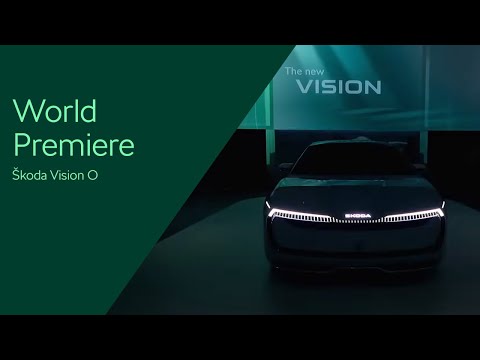
Vision O presents the estate car of the future
At the beginning of September, Škoda Auto unveiled its Vision O electric estate car concept. It takes the Modern Solid design language to the next level and introduces new interior architecture with innovative sustainable solutions. The designers placed maximum emphasis on functionality and the car’s users, while also anticipating the advanced applications of AI and autonomous driving.
Vision O Shows New Perspectives for the Future
Škoda Auto presented a concept for a spacious electric estate car in Munich, Germany. It takes the Modern Solid design language to the next level, focusing on a new interior architecture and the use of sustainable materials.
Topic
Škoda Auto has held a very strong position in the estate car segment for very long time, particularly in Europe. It intends to keep setting the trend. That is why, at the beginning of September, it presented the Vision O electric car concept with this type of body. In addition to a generous luggage compartment with a volume of more than 650 litres, it offers several unique solutions.
Its design, based on the new generation of the Modern Solid language, which it significantly advances, immediately stands out. The wide, robust front end with a new Tech-loop grille and Škoda Cyber Lights headlights features an illuminated Škoda logo, while the B-pillars incorporate the caron from the brand logo. The neutral colour of the bodywork also catches the eye, complemented by paint pigments that transition from blue to yellow. The entire design is, of course, underscored by the car‘s excellent aerodynamic properties, which are enhanced by a number of other features so that the car can use the energy from the battery for the longest possible range.
“From my point of view, the car’s simple and functional appearance draws heavily on the first and second generations of the Octavia, returning to the model’s roots where functionality is paramount,” says Daniel Edr, ED/G – Design Management Coordinator.
Vision O was a particularly special project for me. From the outset, we collaborated closely with other departments, including EDI – Design Interior, UX/UI, and EDE – Design Exterior. Working as one unified team, we spent several months developing the concept, and it was this interdisciplinary collaboration that enabled us to achieve such a compelling result.
Regarding materials, we pursued minimalism as a pathway to circularity. We embraced the principle "Less is really, really more." In practice, this meant employing mono-materials, reducing recycling complexity, and creating a visually clean yet bold design expression.
The close collaboration with interior designers proved invaluable, as we were able to integrate materials at the earliest stages of the process and develop the final design around their inherent properties and capabilities. This approach led to the creation of the headrest, one of the car's most striking features. We began with a material chosen for its flexibility, softness, and sustainable credentials–the component would be manufactured from a single material, ensuring recyclability and enabling zero-waste production. The interior designers then proposed a form and structure that capitalised on these properties. After developing several prototypes, with considerable support from the EDM – Design Modelling and Digitisation department, we produced a headrest that remains firm at its connection point to the seat whilst becoming soft where it meets the occupant's head. This fusion of functionality and sustainability exemplifies what we're striving for in future projects–for me, this represents Modern Solid 2.0.
For the colour concept, the almost achromatic interior supports a fresh direction for HMI (human-machine interface). Rather than drawing attention through excessive contrasts within the interior, our intention was to create more space for the human being–to overwhelm them. We reinforced this human-centred approach with an entirely new ambient lighting solution. Bio-adaptive illumination, or Circadian Light, mirrors external light conditions within the car's interior. The colour spectrum shifts from morning to evening–blue through to red–thereby supporting our natural biorhythms in an intuitive way.
Petra Debnárová
Design Colours and Trim ED/T – Colour and Trim
Vertical and horizontal displays
Even more fundamental innovations are hidden inside the Vision O. The interior places maximum emphasis on the car’s users. It is dominated by a large, vertically oriented display complemented by a rotary controller. A second, horizontal display spans the entire width of the dashboard. The interior design focuses on monochrome aesthetics and simplicity. “The interior design concept of the Škoda Vision O concept reflects our goal of combining simplicity and sustainability with a higher level of comfort,” explains Oliver Stefani, Head of ED – Škoda Design. A special feature is the Tranquil mood mode, in which space in the cabin for work or relaxation will be freed. Bio‑adaptive lighting automatically adjusts to natural light cycles to make it as pleasant as possible for its occupants.
Experience is the key theme of the Vision O show car. Working with all the teams on this project to achieve a holistic result was a tremendous experience for me as well.
Petr Nevřela
Design Exterior EDE/1 – Design Exterior – Team 1
Circularity first
The designers based their work on the principles of the circular economy, which aims to eliminate waste and keep materials in circulation for as long as possible. They therefore focused even more on the use of sustainable materials, which they used, for example, for seat covers. They came up with a very interesting solution for the headrests, which are made of a durable, flexible, and recyclable monomaterial with a special 3D structure resembling a honeycomb. At the same time, they provide passengers with exceptional comfort.
Technology of the future
The Vision O concept signals an entirely new vehicle-control experience. Its advanced technologies include autonomous driving, which enables the car to operate independently, except in very adverse conditions. The digital assistant Laura, equipped with artificial intelligence, is a great companion not only for the driver but also for all passengers.
Meeting of importers
The Munich Motor Show also served as a meeting place for representatives of European Škoda importers, which took place the day after the premiere of the Vision O concept. The main topics included a review of current sales results and strategies for the future. The importers then reviewed competitors’ novelties at the IAA Summit.
Info
With your own eyes
You can take a closer look at the Vision O concept. In October and November, it will be presented at Czech plants, accompanied by complementary activities, including an exhibition of some legendary Škoda cars. The Vision O will also be on display at the Škoda Museum.
Tip
You can read about all the features of the Vision O concept in detail in the online magazine Škoda Storyboard.
Watch the video from the world premiere